


Understanding the 14 Ratnas of the Samudra Manthan
Samudra Manthan, or the Churning of the Ocean of Milk, is one of the most majestic and awe inspiring stories in all of Indian mythology, signifying the churning of the human mind to attain enlightenment. Though the end result of this rigorous churning was the nectar for immortality, or Amrita, the rigorous churning first produced fourteen divine treasures, or the 14 Ratnas, from the ocean, which were then distributed among the gods, demons, and sages. This article is a detailed account of the fourteen extraordinary treasures that emerged from the ocean and their role in the universe.
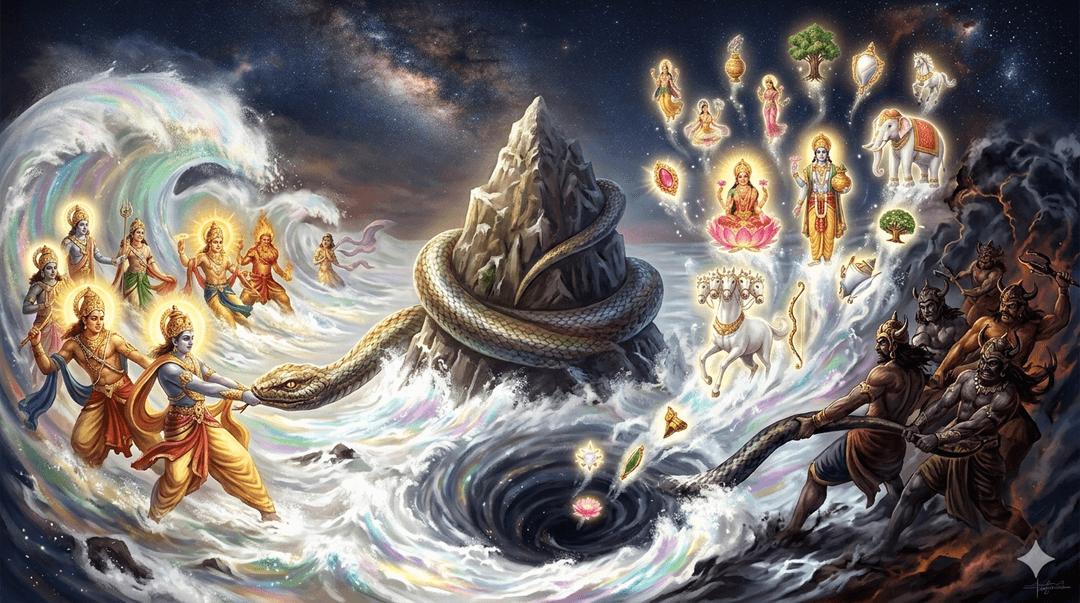
The epic tale of Samudra Manthan in Hindu Puranas tells of how both Devas (gods) and Asuras (demons) united in their endeavor albeit for different reasons to churn the original Ocean of Milk (Kshira Sagara). They employed Mount Mandara as the churning rod and the gigantic serpent Vasuki as the rope. With this apocalyptic churning process in full swing, the ocean started to yield its strongest essence. Prior to the appearance of the much needed Amrita, a list of fourteen divine beings and objects
The First Emergence: Crisis and Sacrifice
The first product of this churning, however, was no treasure, but a dreadful threat to all creation. The Halahala or Kalakuta poison emerged, posing a threat to all creation. This showed that all great endeavors are likely to first reveal the hidden negativities. It needed the supreme sacrifice from Lord Shiva, who swallowed the poison to save the world and got the name Neelkanth.
The 14 Ratnas of Samudra Manthan
| No. | Treasure (Ratna) | Description | Recipient |
|---|---|---|---|
| 1 | Halahala | The lethal poison that surfaced first. | Lord Shiva |
| 2 | Varuni | The Goddess of Wine and intoxicants. | The Asuras |
| 3 | Uchaihshravas | The divine seven-headed white horse. | King Bali (later Indra) |
| 4 | Kaustubha | The most precious diamond in the world. | Lord Vishnu |
| 5 | Sharanga | A powerful celestial bow. | Lord Vishnu |
| 6 | Parijat | The celestial tree with flowers that never fade. | The Devas (Indra's Garden) |
| 7 | Apsaras | Divine nymphs (like Rambha and Menaka). | The Devas (Celestial Dancers) |
| 8 | Lakshmi | The Goddess of Wealth and Prosperity. | Lord Vishnu |
| 9 | Kamadhenu | The wish-fulfilling cow (Surabhi). | Given to Sages (Rishis) |
| 10 | Airavata | The massive four-tusked white elephant. | Indra (King of Gods) |
| 11 | Panchajanya | The divine conch shell. | Lord Vishnu |
| 12 | Chandra | The Moon, which emerged as a deity. | Lord Shiva (wore on his head) |
| 13 | Kalpavriksha | The wish-fulfilling tree. | The Devas |
| 14 | Dhanvantari | The Physician of the Gods carrying Amrita. | The Devas (eventually) |
They are traditionally classified into three categories:
1. The Divine Beings (Gods, Goddesses, and Supernatural Nymphs)
Several powerful deities and supernatural beings emerged directly from the churning waves, assuming their roles in the cosmic hierarchy.
- Lakshmi: The most prominent among the Ratnas, Goddess Lakshmi, the personification of wealth, fortune, and prosperity, appeared radiating divine beauty. She chose Lord Vishnu as her eternal consort.
- Varuni: The Goddess of Wine (representing intoxicants and worldly pleasures). The Asuras claimed her.
- Chandra: The Moon emerged as a deity. Lord Shiva took the crescent moon to adorn his matted hair, signifying his control over time and emotions.
- Apsaras: Divine nymphs (such as Rambha, Menaka, and Punjikasthala) known for their beauty and dance appeared and were accepted by the Devas to reside in the celestial realms.
2. The Wish-Fulfilling and Mythological Animals
Two iconic wish granting creatures and a majestic mount were unearthed during the process.
- Kamadhenu (Surabhi): The wish fulfilling cow, capable of granting any desire. She was given to the Sages (Rishis) to support their sacrificial rituals.
- Airavata: The massive, four tusked white elephant. It became the regal mount of Indra, the King of Gods.
- Uchaihshravas: The divine, seven headed white horse, possessing supernatural speed. Initially taken by the Asura King Bali, it eventually came to Indra.
3. Divine Objects, Plants, and Weapons
The ocean also yielded objects of immense power, significance, and utility.
- Kaustubha: The most brilliant and flawless diamond in the universe. It was accepted by Lord Vishnu and is often depicted on his chest.
- Sharanga: An immensely powerful celestial bow, which was given to Lord Vishnu.
- Panchajanya: The divine conch shell, which Lord Vishnu claims as one of his principal attributes. Its sound strikes terror in the hearts of demons.
- Kalpavriksha: The celestial wish fulfilling tree, which grants any boon asked beneath it. It was planted in Indra’s celestial garden.
- Parijat: The divine flowering tree with blossoms that never fade. It was also placed in the Deva realm.
- Dhanvantari and Amrita: Finally, the physician of the gods, Dhanvantari, emerged carrying the golden pot of Amrita, the nectar of immortality.
The distribution of the 14 Ratnas illustrates the dual nature of Devas and Asuras, who are both conflicting and complementary, while emphasizing the supremacy of the deities that control the balance of the universe.