


Manu and Shatrupa: The Origin Story of Humanity
How did human life actually begin according to Hindu mythology? Discover the profound story of Manu and Shatrupa and why there is no 'Original Sin'.
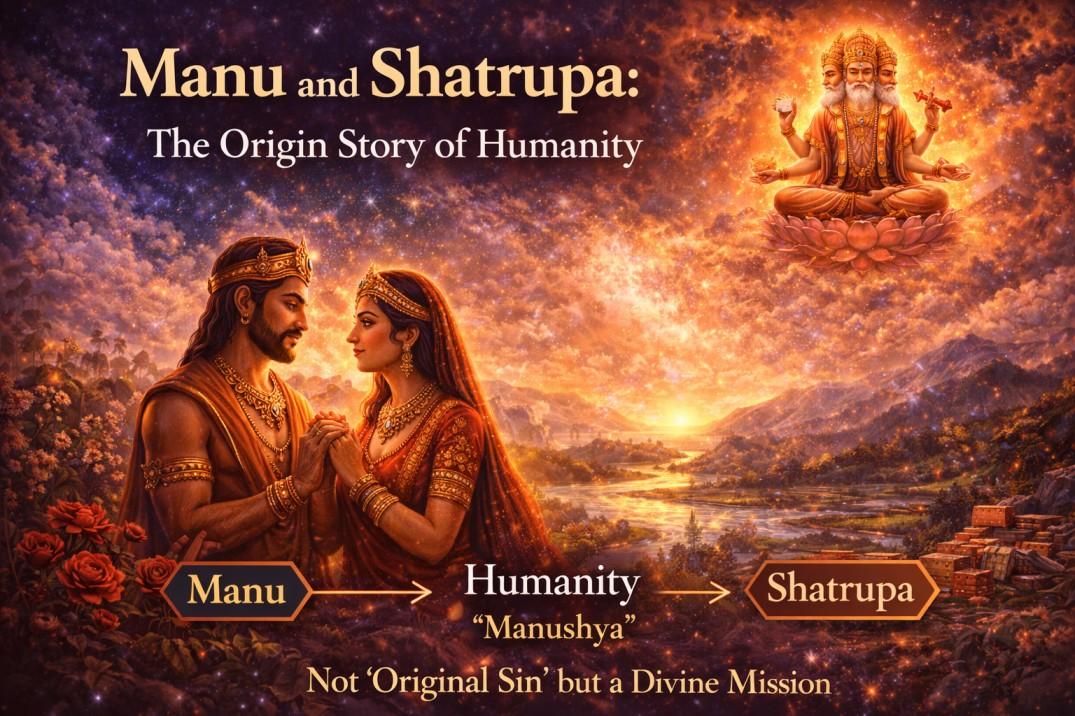
In the Western world, almost everyone knows the story of Adam and Eve. It is a story heavily rooted in temptation, a forbidden apple, a cosmic mistake and ultimately an angry expulsion from Paradise. It introduced the heavy concept of “Original Sin” - the idea that humanity was born out of a massive planetary failure.
But if you look into the ancient Puranas of Hindu mythology the origin story of humanity feels completely different. There is no angry god, no forbidden fruit and absolutely no original sin. Instead, the creation of the first man and woman is a story of profound cosmic loneliness, brilliant equality and a divine mission.
This is the story of Swayambhuva Manu and Shatrupa.
The Loneliness of the Creator
According to the ancient texts, Lord Brahma (the creator of the universe) had already formed the physical planets, the massive oceans, the heavenly deities (Devas) and the ferocious demons (Asuras). He had even created mind-born sons known as the Manasputras to help him govern the cosmos.
But as Brahma looked down at the beautiful, fertile Earth (Bhumi) functioning below, he realized something was missing. The Earth was entirely empty of conscious mortal life. The gods lived in the heavens and the demons lived in the underworld but who would experience the physical beauty of Earth? Who would uphold Dharma (righteousness) in the mortal realm?
Brahma fell into deep meditation. In his intense desire to create a perfect mortal being capable of both logic and intense love, the ancient texts say Brahma literally split his own divine body into two equal halves.
The Birth of “Manushya”
From the right side of Brahma emerged a spectacularly radiant man. He was named Swayambhuva Manu.
Swayambhuva translates to "the self-born", because he did not have a human mother, he came directly from the Creator.
The word Manu represents the archetype of human intelligence and reason. In fact the Sanskrit word for a human being - Manushya - literally means "the descendant of Manu".
From the left side of Brahma emerged an equally radiant woman. She was named Shatrupa, which beautifully translates to “the woman of a hundred magnificent forms.” She was not created as an afterthought or a subordinate. She was created simultaneously as the perfect equal balance to Manu holding the divine power of grace creation and physical life.
Brahma looked at the first mortal couple and gave them a very simple instruction: “Go to Earth. Populate it. Enjoy its beauty but protect its balance.”
The Myth of “Original Sin”
This is where the Hindu creation story drastically breaks away from Western mythology.
Manu and Shatrupa were never punished for being human. They were not exiled from heaven for making a mistake. In Vedic philosophy, being born as a human on Earth is not a cosmic punishment, it is considered an incredibly rare privilege. Out of millions of species the human form is the only one capable of achieving Moksha (ultimate spiritual liberation).
When Manu and Shatrupa descended to Earth they became the first Grihasthas (householders). They built the first society defined the first laws of human duty and had five children. Their absolute devotion to their duty (Karma) became the foundational blueprint for how a human should live. They proved that you do not need to sit in an isolated mountain cave to be holy. Raising a family, upholding truth and running a society is equally divine.
The Cosmic Clocks (Manvantaras)
In Hindu cosmology time does not just move in a straight line, it moves in massive repeating circles.
Just as our daily human lives are heavily influenced by the micro-cycles of planetary motion and daily timing rules like Rahu Kaal, the universe itself operates on massive macro-cycles called Manvantaras.
A Manvantara is the massive epoch or lifespan of one specific Manu. According to the texts we are currently living in the 7th Manvantara of the current cosmic cycle. Swayambhuva Manu was the ruler of the very first Manvantara setting the original code of conduct for all the cycles that would follow.
The Modern Takeaway
The story of Manu and Shatrupa is incredibly relevant today because it perfectly re-frames how we should view our own existence.
You are not on Earth because your ancestors made a mistake. You are here because the Creator wanted to experience the physical world and split itself into billions of human forms to do exactly that. The next time you feel completely overwhelmed by the crushing pressure of your daily career karma or social duties remember the absolute first instruction given to humanity: Populate it, Enjoy its beauty but Protect its balance
We are all descendants of Manu. We are the universe experiencing itself.
Tags: