


Are Eclipses Really Inauspicious? Astronomy vs Astrology Explained
Eclipses have terrified and fascinated humanity for centuries. But are they actually bad omens? Science and Vedic astrology offer very different — and surprisingly compatible — answers.
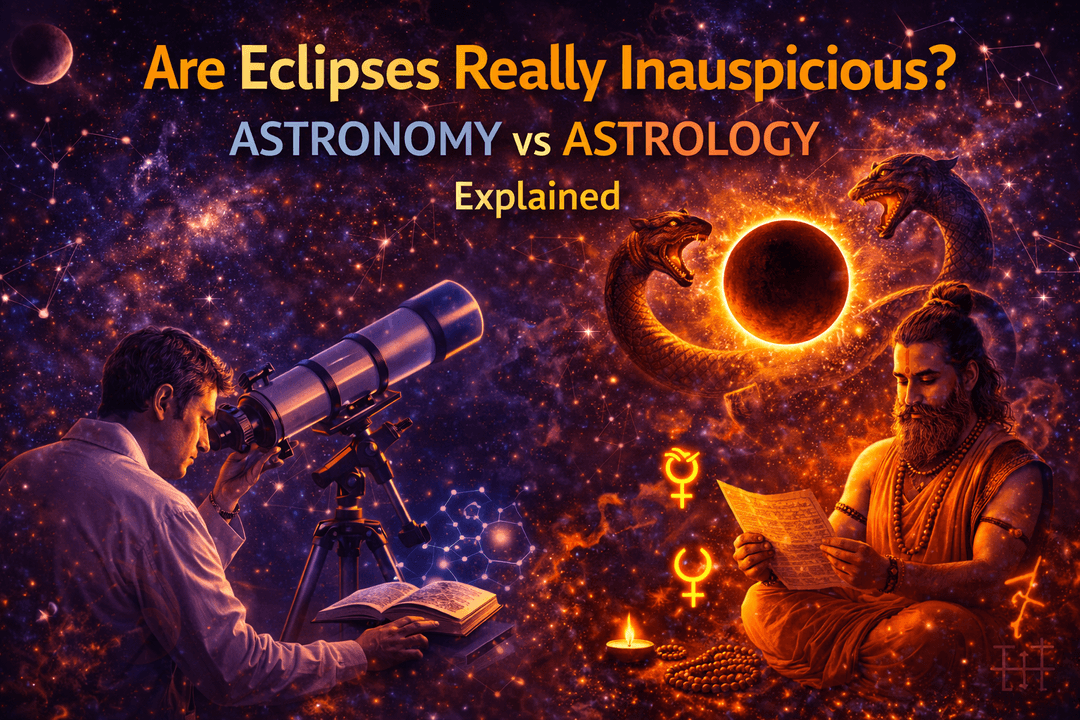
Somewhere in India right now, a family is covering their food, refusing to cook, and staying indoors — all because the Moon has moved into the Earth's shadow. People are warned not to step outside, not to eat, not to pray in temples, not to begin new work.
And somewhere else, an astronomer is watching the same event through a telescope, utterly calm, taking photographs and measurements.
Both of them are responding to an eclipse. One with fear and ritual, the other with wonder and data. Are either of them wrong?
What Is Actually Happening During an Eclipse
Let us strip it down to physics first.
A solar eclipse (Surya Grahan) occurs when the Moon passes directly between the Earth and the Sun, temporarily blocking the Sun's light. A lunar eclipse (Chandra Grahan) occurs when the Earth moves between the Sun and the Moon, casting its shadow onto the lunar surface.
Both are predictable, cyclical and entirely safe in terms of cosmic radiation. Modern satellites do not lose power. Animals adjust their behavior briefly and return to normal. The oceans are barely affected beyond their ordinary tidal patterns.
No special harmful radiation is emitted. No mysterious forces are unleashed. Scientifically, an eclipse is simply an alignment.
So why has every major civilization on Earth — from ancient Greeks to Babylonians to Indians — treated eclipses with extraordinary reverence or fear?
The Mythology Behind the Fear
In Vedic tradition, the story of eclipses is rooted in the tale of Rahu and Ketu. During the cosmic churning of the ocean (*Samudra Manthan*), a demon disguised himself among the gods and drank some of the sacred nectar (*amrit*). Lord Vishnu, alerted by the Sun and Moon, immediately severed the demon's head with his Sudarshan Chakra.
But the demon had already tasted the nectar. He became immortal — split into two shadow entities: Rahu, the disembodied head, and Ketu, the headless tail.
Holding an eternal grudge, Rahu and Ketu periodically "swallow" the Sun and Moon in revenge. Since the Sun and Moon alert Vishnu, Rahu swallows them — but because they are divine, they pass through and reappear. That moment of swallowing is what produces the eclipse.
This is a strikingly accurate mythological description of what happens astronomically. Rahu and Ketu, in Vedic astrology, represent the two mathematical intersection points of the Moon's orbit with the Earth's orbital plane around the Sun. These are called the lunar nodes. Eclipses only happen when the Sun or Moon is close to these nodes. The mythology and the mathematics describe the exact same phenomenon in different languages.
What Vedic Astrology Actually Says (vs What Gossip Says)
There is a significant difference between what genuine Vedic thought says about eclipses and what has been amplified through fear-driven cultural tradition.
What Vedic astrology actually teaches:
- Eclipses are powerful moments of karmic acceleration. Because the Sun (consciousness, identity, authority) and Moon (mind, emotions, intuition) are momentarily disrupted, it is considered an unstable time for external decisions — especially new beginnings.
- Ancient texts advise spiritual practice, meditation, chanting and introspection during eclipses — not out of fear but to take advantage of the heightened energetic sensitivity.
- The "inauspiciousness" is specifically about the time of the eclipse itself and a short period around it, not weeks or months.
What cultural gossip has added:**
- Food becomes poisonous during an eclipse (false — there is zero scientific basis).
- Pregnant women must not move (this extreme restriction is not rooted in classical texts).
- Any action taken during an eclipse will permanently fail (this is an absolutist distortion of the original guidance).
The common astrology myths that people still believe often follow this pattern — a kernel of ancient wisdom gets exaggerated into blanket fear across generations of uncritical repetition.
Are Horoscopes and Eclipses Connected?
In practice, Vedic astrology does connect eclipses to individual birth charts in a meaningful way. If an eclipse falls on or very close to the position of your natal Sun, Moon, or a key planet in your chart, that eclipse is considered personally significant for you during that year.
This is not a cosmic punishment — it is a triggering event. A Surya Grahan conjunct your natal 10th House can indicate major shifts in career or public reputation. A Chandra Grahan on your natal Moon can bring emotional clarity after a period of confusion or signal an important turning point in personal relationships.
This nuanced view contrasts sharply with the idea that eclipses are dangerous for *everyone* equally. Horoscopes are not meant to be generic predictions — they are personal maps, and an eclipse only becomes truly meaningful when it specifically intersects your individual chart. If you want to check whether an upcoming eclipse touches key positions in your chart, you can generate your free kundali and compare the degrees.
A Rational Way to Approach Eclipses
Avoiding extreme decisions or important beginnings during an eclipse is sensible — the same way you would avoid signing a major contract when you are emotionally overwhelmed or physically exhausted. It is not cosmically forbidden; it is simply poor timing.
Using the period for quiet reflection, spiritual practice or completing existing tasks rather than launching new ones is the original Vedic prescription. That is genuinely useful guidance.
Covering food out of excessive fear, restricting all movement or treating the eclipse as an attack from malevolent forces is a distortion — and one that has unfortunately overshadowed the deeply intelligent framework underneath.
The Takeaway
Eclipses are not inauspicious by nature. They are moments of cosmic alignment that Vedic tradition correctly identified as energetically sensitive windows.
Ancient astronomers knew exactly what caused them. They encoded this knowledge in the story of Rahu and Ketu — and that story maps perfectly onto the mathematics of lunar nodes. The wisdom was always there. What got lost over centuries was proportion.
An eclipse is worth being mindful about. It is not worth being afraid of.
Tags: